
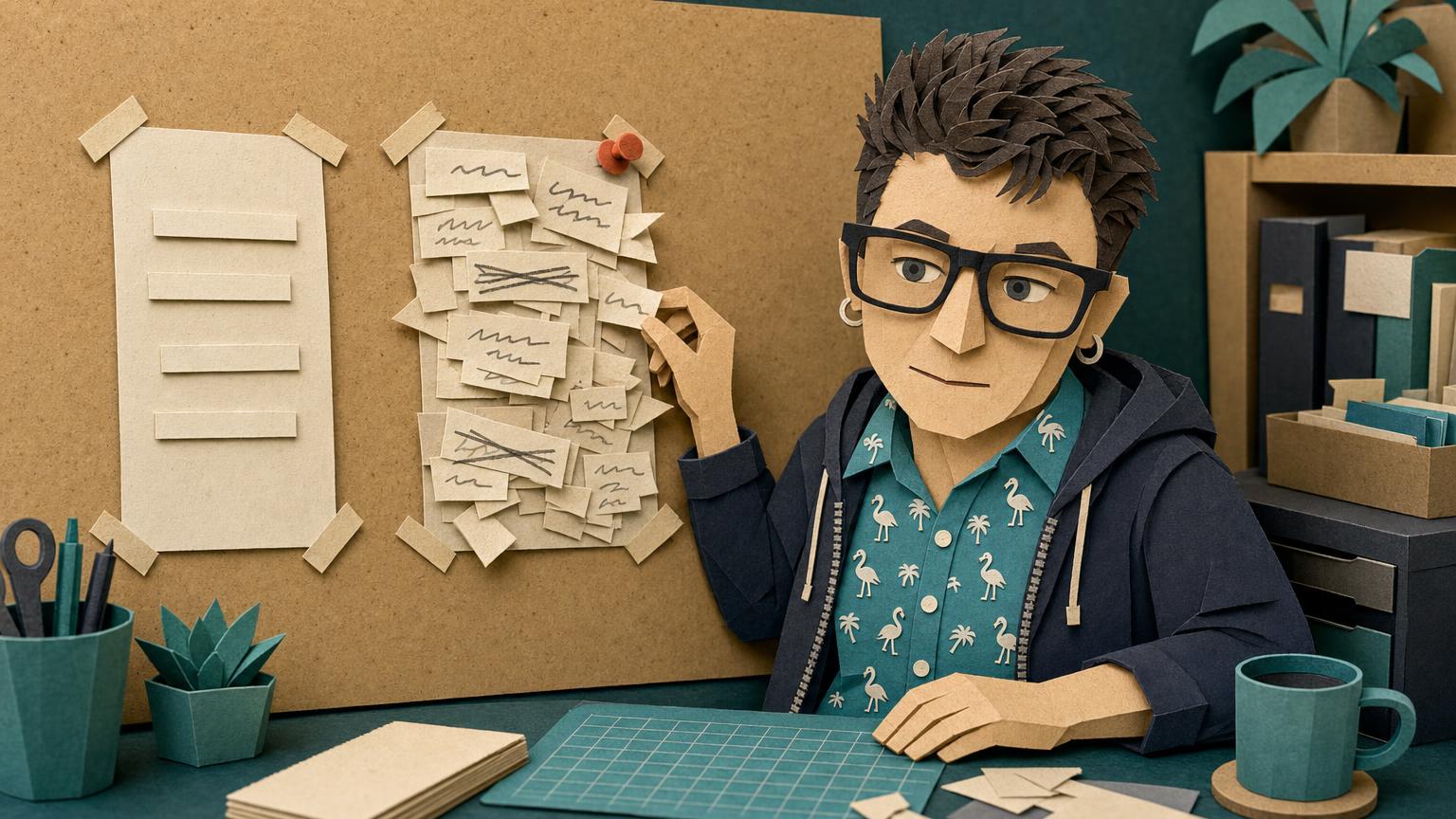
To document what actually happens, you write down every real step as it occurs, including the workarounds, the delays, and the part where you stop to ask someone a question, instead of writing the polished version you would show in a meeting. The clean version fails because nobody can follow steps that were never really there.
- The document that reflects real work includes the ugly parts, because those parts are where the actual decisions live.
- Writing down what actually happens is a different job than writing down what should happen, and confusing the two keeps the work glued to you.
- The clean version fails because it describes a process nobody has ever run.
- You capture the real process by narrating it out loud while you do it, not by remembering it afterward.
- The preliminary stuff and the did-she-do-it question both belong in the record, even when they feel too small to write.
- You are the document until the document can stand without you.
There is a line I keep coming back to. Someone described handing off a task like this: “I got to tell her all the preliminary stuff and I got to ask her: Did she do it?” That is the whole problem in one sentence. The work got written down somewhere. The documentation exists. And it still came back around, because writing it down was never the same job as getting out of it. To document what actually happens, you have to capture the preliminary stuff and the follow-up question, not just the shiny middle part.
What does it mean to document what actually happens?
To document what actually happens means recording the real sequence of a task as it unfolds, including the workarounds, the pauses, the side conversations, and the manual checks, rather than the sanitized version you would present to a room. The clean version describes how work should go. The real version describes how it actually goes. Those two things are almost never the same, and the gap between them is exactly where tasks keep bouncing back to you.
Researchers have a name for this gap. They call it the difference between work-as-imagined and work-as-done. Work-as-imagined is how we think the job should be done, and work-as-done is the direct experience of the person actually doing it. Your deck is full of work-as-imagined. Your real process is work-as-done, and it has the fingerprints all over it.
Writing down what should happen is a different job than writing down what actually happens, and only one of them gets the work off your plate.
Why does the clean version always fail?
The clean version fails because it describes a process nobody has ever actually run, so the first time someone hits a step that was smoothed over or left out, they stall and bring the task straight back to you. Every deletion you made for tidiness is a question somebody will now have to ask. You removed the mess to look organized, and the mess was the instructions.
Here is the part people miss. The preliminary stuff you skip because it feels obvious is the part that is only obvious to you. The side-check where you glance at one specific field before moving on, the odd order you do two steps in because doing them the other way breaks something, the quick message you send to confirm before you proceed. None of that makes the deck. All of it makes the job.
A study of laboratory workers found the same thing. Interviews with fifteen people showed they did not always follow the written procedures, and the gaps came mostly from time pressure. The authors’ recommendation was plain: consult the people who actually do the work. You are those people. You are the document until you write the real one.
How do you capture the real process, ugly parts included?
You capture the real process by narrating the task out loud while you do it and recording every move in order, including the parts you would normally edit out, so the record matches reality instead of matching your idea of reality. Do not reconstruct it from memory afterward. Memory tidies. Memory removes the three seconds where you squinted at the screen and the reason you squinted.
The method breaks into four moves. I think of them as Note, Refine, Deliver, with one step before Refine that most people rush.
- Note it live. Do the task and write down each step as it happens. Talk through it. “Now I open this. Now I check that this number matches. Now I wait for the reply before I send the next thing.” Capture the preliminary stuff and the did-she-do-it question both.
- Keep the ugly. Leave in the workaround, the wait, the manual copy-paste, the thing you only know because it broke once. This is the step people skip, and skipping it is why the document bounces back.
- Refine for the next person. Now cut the noise, not the substance. Clarify wording. Order the steps. Mark which checks are required and which are habit. You are refining, not sanitizing.
- Deliver and test. Hand it to someone and watch them run it without you in the room. Every question they ask is a hole in the document. Fill the hole. Repeat until nobody has to ask you anything.
Process mapping people do a version of this. The as-is map documents how work actually happens, including the workarounds, delays, and manual steps, not the ideal SOP. You are drawing your own as-is map. The ugly parts are not clutter. They are the map.
The clean version versus the real version
Here is the difference laid side by side.
| The clean version (the deck) | The real version (what actually happens) |
|---|---|
| Five tidy steps in a straight line | Five steps plus two checks, one wait, and a question you send first |
| Assumes everything works | Notes the one thing that breaks and how you route around it |
| Written from memory, after the fact | Captured live, in order, while doing the task |
| Looks organized | Actually runs without you |
Why does the messy version get permission here?
The messy version gets permission because an honest account assumes the person acted with good intentions and captures what really occurred, and a tidy account hides the problems that the next person needs to see to do the work without you. When you scrub a document to look competent, you push the real friction out of sight.
The engineering teams who write blameless postmortems understand this. The whole premise is that a blame culture pushes problems out of sight, while an honest write-up keeps them visible so they can be fixed. Your documentation deserves the same honesty. Nobody is grading you on how clean your process looks. They are grading you on whether the task finally leaves your hands.
You are the document until the document can stand without you in the room.
So give yourself permission. Write the ugly version first. Write the part where you wait. Write the part where you ask someone did she do it. Write the squint. You can always refine later, but you cannot refine something you never captured. If you want a place to think this through out loud with people doing the same work, the community is built for exactly this kind of honest documentation.
The terms “work-as-imagined” and “work-as-done” come from the field of resilience engineering and safety science, where researchers found that the gap between the two is not a failure of the workers but a normal and expected feature of complex systems. The gap is the data, not the defect.
Almost every time I open a client’s existing documentation, I find a clean list of steps that reads beautifully and works for nobody. The person who wrote it did the task so many times that the real moves became invisible to them. The check they do without thinking, the message they send before step one, the field they glance at. None of it is written down because none of it feels worth writing. That invisible layer is the entire reason the work keeps coming back. When we rebuild the document live, narrating each move, the page triples in length and the task finally stops returning.
How do I document a process that only I know how to do?
Narrate it out loud while you do the task for real, and write down every move in the order it happens. Do not reconstruct it from memory, because memory removes the steps you do automatically. Those automatic steps are the ones the next person will stumble on. Capture the task live, ugly parts and all, then clean it up afterward.
Why does my documentation keep failing when I hand it off?
It fails because you wrote the version you would present, not the version that actually runs. The clean version skips the preliminary steps and workarounds that only you know. Every step you smoothed over becomes a question the next person has to ask you, which pulls the task right back to your desk.
What should I include in a process document that I usually leave out?
Include the waits, the checks, the workarounds, and the small questions you ask before you start. Include the one step that breaks if you do it in the wrong order, and the reason. These feel too small or too messy to write down, which is exactly why leaving them out is what makes the document useless.
Is it better to write a rough version or wait until I can write a clean one?
Write the rough version first, every time. You can refine something you captured, but you cannot refine something you never wrote. A messy, honest record of what actually happens beats a polished document describing a process nobody has run. Capture first, clean later.
How do I know when my documentation is actually done?
It is done when someone else runs it without you in the room and does not have to ask you a single question. Watch them do it. Every question they raise is a hole in the document. Fill the holes and test again until the task runs on its own.
What is the difference between work-as-imagined and work-as-done?
Work-as-imagined is how you think the task should go. Work-as-done is how it actually goes when a real person does it under real conditions. Good documentation records work-as-done, because that is the version that includes the friction and detail the next person needs.
Pick one task that keeps coming back to you. The next time you do it, narrate every move out loud and write down what actually happens, including the preliminary stuff and the part where you stop to ask did she do it. Keep the ugly in. Refine it later. Then hand it to someone and watch for the holes.
Save this for the next time you sit down to document something.
… and see more of my posts in your Google results.