
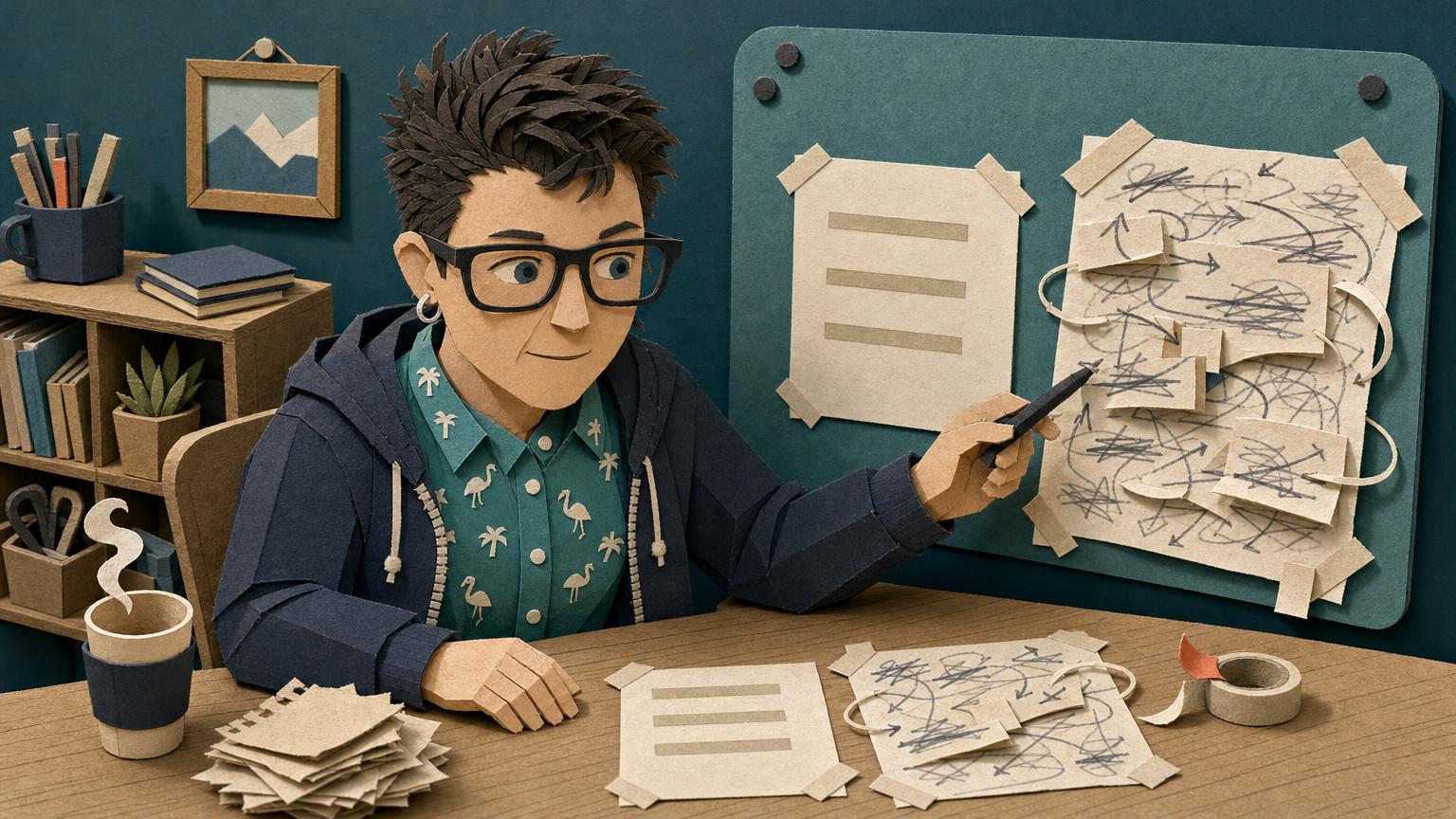
To document the real process, you write down what actually happens on the ground, including the backtracking, the waiting, and the person you had to ask, instead of the clean version you would put in a deck. The clean version fails because nobody can follow it when the real work diverges. Capture the ugly parts first, then refine.
- The real process includes the interruptions, the person you had to chase down, and the step you repeated twice, not just the tidy arrows.
- The clean version fails because it describes work-as-imagined, and the person following it is doing work-as-done.
- Capture happens best in the moment, while you are still telling someone what you did, not days later from memory.
- The documentation existing does not mean the work stops coming back to you, because writing it down was never the same job as getting out of it.
- You are the document until the document can stand without you, and it only stands if it tells the truth.
- An honest account only gets written when nobody gets punished for the ugly parts.
There is a line I keep coming back to from someone describing a handoff. “I got to tell her all the preliminary stuff and I got to ask her: Did she do it?” That is the whole thing right there. The preliminary stuff. The did-she-do-it. When you document the real process, that is exactly what you are after, and it is exactly what gets left out of the pretty version. You have to note what actually happened, ugly parts included, or the document is a lie that someone will eventually trust.
Most documentation gets written for an audience that does not exist. It gets written for a reviewer, a slide, a sense that things are under control. Then the person who actually needs it opens the file, hits step three, and finds out step three assumes something that was never true.
What does it mean to document the real process?
To document the real process means to write down the actual sequence of what happened, including the detours, the waiting, the person you had to ask, and the step you redid, rather than the streamlined version you would present to a boss or a client. The real process has friction in it. The clean version sands that friction off, and the friction was the part worth recording.
Here is the distinction that makes this concrete. There is work-as-imagined, which is what a manager or designer believes happens. Then there is work-as-done, which is what the person actually does to get the task finished under real conditions. The gap between those two is not a flaw in your people. It is where all your real knowledge lives, and it is exactly what your documentation usually throws away.
Writing something down was never the same job as getting out of it. The document existing is step one, not the finish line.
Why the clean version fails
The clean version fails for one reason: it describes a process nobody actually runs. Formal procedures assume work-as-imagined matches work-as-done, and it never fully does, because people adjust constantly to changing conditions. The Safety-I to Safety-II white paper makes this point plainly. When you document only the ideal path, you hand the next person a map of a road that was paved in your imagination.
The research on work-as-imagined versus work-as-done adds the part that stings. People get tasks finished despite obstacles, and then they do not report the obstacles. The workaround becomes invisible. Nobody writes down the thing they had to do to make it work, so the next person rediscovers it from scratch.
How do you capture the ugly parts without lying to yourself?
You capture the ugly parts by writing the process while you are still doing it or immediately after, narrating out loud as if telling one specific person, and refusing to tidy the sequence until the whole mess is on the page. The order matters: note first, clean later. If you clean while you capture, you edit out the truth before it is ever recorded.
Narration is the trick. The anchor line works because the person was telling someone. “I got to tell her all the preliminary stuff.” When you explain a task to a real human, you include the parts you skip when writing for a file. You say “oh, and you have to wait for the thing to load before you click save, otherwise it eats your work.” That sentence never makes it into a deck. It is the most useful sentence in the document.
Here is the capture method I use, start to finish.
- Note. Do the task and talk through every move out loud, to a person or a recording. Capture the detours, the waiting, the “wait, I forgot to” moments. Do not fix anything yet.
- Eliminate. Read it back and cut only the noise that is genuinely irrelevant. Keep every workaround. Keep the did-she-do-it checks. Cut the throat-clearing, not the friction.
- Refine. Now impose order. Number the steps. Flag the decision points. Mark the spots where a human has to check on another human.
- Deliver. Hand it to someone who has never done the task and watch them run it. Where they stall, your document lied. Fix that spot.
Notice there is no template here. A template would make you fill in boxes, and the truth does not fit in boxes. The capture is a transcript first and a structure second.
If the next person stalls where your document said everything was smooth, the document was fiction and you are still the document.
What belongs in the ugly version
The parts people delete are usually the parts worth keeping. Here is what earns its place.
- The person you had to ask, and what you asked them.
- The wait times that have no visible cause.
- The step you do out of order every single time because the official order does not work.
- The thing that breaks if you skip it, even though it looks optional.
- The check you run to confirm the last person actually did their part.
Why does the work still come back to you after you document it?
The work comes back because documenting a task and removing yourself from it are two different jobs, and finishing the first does not finish the second, so you still end up fielding questions the document should have answered but did not. A document only removes you when it can stand on its own in front of a stranger. Most cannot, because they were written clean.
You are the document until the document can hold the weight alone. That is not a failure of discipline. It is the natural state of a document that has not yet been tested against a real person doing the real work. The fix is not more writing. The fix is honest writing, then a live run.
| The deck version | The real process |
|---|---|
| Step 3: Submit the request | Step 3: Submit the request, then message Dana because the system does not notify her |
| Approval happens | Approval sits for a day. Follow up Thursday if you have not heard back |
| Export the file | Export the file, but wait for the spinner to stop or it exports half |
| Done | Check that the prior step was actually finished before you call it done |
The left column is what you would put in a deck. The right column is what gets the job done at two in the afternoon when something is already behind. One of these keeps the work on your desk. The other one gets it off.
The honesty problem
You cannot write the ugly version in a place where the ugly version gets you in trouble. The Google SRE postmortem culture guidance is built on this: an honest account only gets written when people are not punished for it. If naming the workaround gets someone scolded, the workaround stays unwritten and the next person inherits the blank spot. Document the real process in a space where the truth is safe to say.
A document written to impress the reviewer is useless to the person who has to run the task at full speed.
The Google SRE example postmortem includes a section literally titled “Where we got lucky.” Writing down the parts that only worked by luck is treated as a professional discipline, not an embarrassment, because the luck will not hold next time.
Almost every time I open a client’s existing documentation, I find a file that reads like a brochure and a person who still answers the same three questions every week. The questions are always about the gaps the brochure skipped. The export that eats your work. The person you have to nudge. When we put those gaps into the document word for word, the weekly questions drop, because the thing finally says out loud what the writer was carrying in their head.
How do I document a process that only I know how to do?
Narrate it out loud while you do it and record yourself. Do not write first. Talking to an imagined person pulls out the shortcuts and warnings you skip when typing. Then transcribe, cut only the noise, and keep every workaround. The messy transcript is your first real draft.
Why does my documentation not work when someone else tries to follow it?
Because it describes the process you imagine instead of the one you run. The gap shows up exactly where you stall them. Watch someone new attempt it, mark every point they get stuck, and fix those spots. Each stall is a place where you cleaned out something true.
What should I include that most process docs leave out?
Include the people, the waits, and the checks. Who you ask, where things sit for no visible reason, and how you confirm the last person did their part. These are the parts deleted for looking unprofessional, and they are the parts that keep the work on your desk when they go missing.
Should I clean up the process as I write it down?
Not at first. Capture the whole mess, then refine in a separate pass. Cleaning while capturing edits out the truth before it is recorded. Note everything, eliminate only genuine noise, refine the order, then deliver and test it live.
Does good documentation mean the work stops coming back to me?
Only if the document can stand without you. Writing it down and getting out of it are separate jobs. A document removes you when a stranger can run it start to finish without asking. Until then, you are still the document, no matter how many files exist.
The next time you sit down to document something, do one thing differently. Narrate the whole ugly version out loud before you clean a single line. Note, then eliminate, then refine, then deliver it to a real person and watch where they stall.
Save this for the next time you sit down to document something.
… and see more of my posts in your Google results.